
Bitcoin myths bitcoin image on background of trueful words.

The Biggest Bitcoin Myths, Debunked

Ever since 2009 when Satoshi Nakamoto unleashed Bitcoin: A Peer-to-Peer Electronic Cash System,” his whitepaper that introduced the world to Bitcoin (BTC), it has revolutionised how people perceive money and currency; decentralised, secure, and anonymous.

“It’s a Ponzi scheme.” “It’s the currency of drug dealers and the dark web.” “It costs more to make than it’s worth.” “It’ll never go mainstream.” “It lacks stability and is subject to fluctuation.” These are just a few of the myths people tend to have about Bitcoin and other cryptocurrencies—and there’s some truth behind these statements.

Myth 1# Bitcoin Gains Aren’t Taxed

This is only partially correct. It depends on how you use your Bitcoins. Generally, if you use your Bitcoins for purchases or sales of goods or services, then any capital gains or losses are taxable events that must be reported on your tax return.

This is done regardless of whether you received cash or other property in exchange for your Bitcoins. If you hold onto Bitcoins hoping they will appreciate over time, then any capital gains are not taxed until you sell or exchange them for other property.

Myth 2# Bitcoin Is a Bubble

While it’s true that some people buy Bitcoin as investors seeking a big payout, the digital currency itself is not a bubble. Bubbles are economic cycles characterised by a rapid fall in the market.

The dot-com bubble was driven by the rapid rise of companies like Amazon and Google, which were still in their early stages when they went public. By contrast, cryptocurrencies are still relatively new, with many projects not yet ready for mass adoption or even having any real-world use cases.

Myth 3# Bitcoin Is Too Volatile to Be Useful as Money

Bitcoin has proven to be highly stable compared to traditional currencies over time. But it still fluctuates widely in value relative to the dollar and other fiat currencies, such as the euro and the Japanese yen.

This volatility makes it difficult for companies to accept Bitcoin as payment without incurring a loss on every transaction. As more merchants begin accepting Bitcoin, its volatility will decrease significantly, making it a more attractive alternative currency.

Myth 4# Bitcoin Has No Real-World Uses

Critics like to claim that Bitcoin isn’t valuable in the real world and is only used by criminals. This is false. While it is true that Bitcoin can be used for illegal purchases, that’s not its primary use case.

Bitcoin is a digital currency that can be exchanged for goods and services just like any other currency. Many people are using Bitcoin to pay for everyday things like coffee or pizza at restaurants and grocery stores around the world. Even more, Airbnb allows hosts to accept payment in Bitcoin; Dish Network accepts BTC for services like satellite TV equipment installation; and the U.S. Federal Election Commission allows political donations in BTC.

Myth 5# Bitcoin Transactions Are Anonymous

Some critics claim that Bitcoin transactions are anonymous because they don’t require any personal information from users during purchase (like credit cards do). However, this is not entirely true.

When you send someone money through a cryptocurrency exchange or wallet service provider like Coinbase, they will know your public key address (a string of random numbers and letters) as well as the amount of BTC you sent.

Myth 6# Bitcoin is Bad for the Environment

Bitcoin mining is an energy-intensive process. But determining the environmental impact is hard. For another thing, we don’t know how much energy would be used if Bitcoin didn’t exist — or if it did exist but wasn’t mined using computers.

Finally, it’s important to remember that Bitcoin mining is only one part of a larger ecosystem that includes exchanges, payment processors and users like you and me. Some people argue that these other parts are more important than mining in terms of the overall impact on global warming because they’re larger than mining operations.

Parting Shot

Despite Bitcoin being a legal currency for exchange, many countries remain hesitant to accept it. This hesitation has led to many rumours about Bitcoin’s legality. The use of Bitcoins in online transactions is already taking off and will continue to do so as its popularity increases, thus rendering these myths false. It isn’t easy to imagine that any country would be able to stop its use.

Image Source: Adobe Stock

Disclaimer: This article is provided for informational purposes only. It is not offered or intended to be used as legal, tax, investment, financial, or other advice.

Read more →

A blue background with a bitcoin symbol, highlighting its connection to the blockchain genesis block.

Bitcoin’s 14th Anniversary: Looking Back at The Genesis Block

January 2023 marks the 14th anniversary of the creation of Bitcoin’s Genesis block by Satoshi Nakamoto. January 3, also known as Proof of Keys day, helps us reflect on the life of the Genesis block and Bitcoin.

In 2009, Satoshi Nakamoto created the first cryptographic block, the Genesis block. Its creation ushered in a series of dominoes, giving birth to an entirely new movement. Nakamoto’s creation has been recreated several times since 2009, and over the years, the aim of the Genesis block has become more definitive than ever.

The Chancellor of the Exchequer, on the brink of the second bailout for banks, is conceivably the most famous phrase concerning the Genesis block. Aside from its deeper philosophical meaning, the term stands for what Bitcoin set out to oppose. The manifesto presented by the Bitcoin movement against the centralised financial system was simple: to give people, us, economic freedom.

Bitcoin seeks to overthrow the existing financial system used by banks, which is a monetary system that Banks or governments can manipulate to benefit an entitled group of people. With Bitcoin, the playing field was levelled. Everyone now has the same opportunities irrespective of race, gender, political affiliation, or religion.

Bitcoin’s dream was realised due to its core values and characteristics. Since the software’s protocol was run and thoroughly executed by nodes around the globe, Bitcoin enabled us to attain financial freedom.

Since its inception, the number of Bitcoin-related activities has grown exponentially. However, this comes at a disadvantage. Some of the core principles that were Bitcoin’s stepping stone are now being ignored or forgotten. Activities such as buying, selling, withdrawing, and custody services have centralised the franchise.

On the brighter side, though, this somewhat centralisation has made the industry face less opposition.

Despite Bitcoin holders having several requirements to meet to detach themselves from a centralised system altogether, we also want to briefly examine the Proof of Keys day.

Proof of Keys

The event celebrated annually has the same birthday as the Genesis block. It was started by Trace Mayor and featured BTC users withdrawing their BTC from companies in mass. Tracer said this was to ensure that these institutions weren’t practising centralised financial methods.

Another critical aspect to consider as we celebrate the Genesis block is the “keys.” Essentially, there are two types of private and public keys. However, we’ll focus more on private keys. As the name suggests, private keys are the only way to spend the BTC in your wallet. With them, you can access or spend your BTC. This is because, on every BTC transaction, the sender places a “lock” on the Bitcoins loaded with the user’s information. Thanks to asymmetric cryptography, only the receiver can access these BTC, which also possess their keys. This, therefore, means that only the receiver influences their Bitcoins.

However, if you have a third-party firm storing the Bitcoin for you, they possess your private keys. Therefore, no special permission is required to move your BTC. In most cases, this process is automated. Nonetheless, it is still essential to enable you to move your Bitcoins, primarily through processes such as withdrawal requests.

In Conclusion

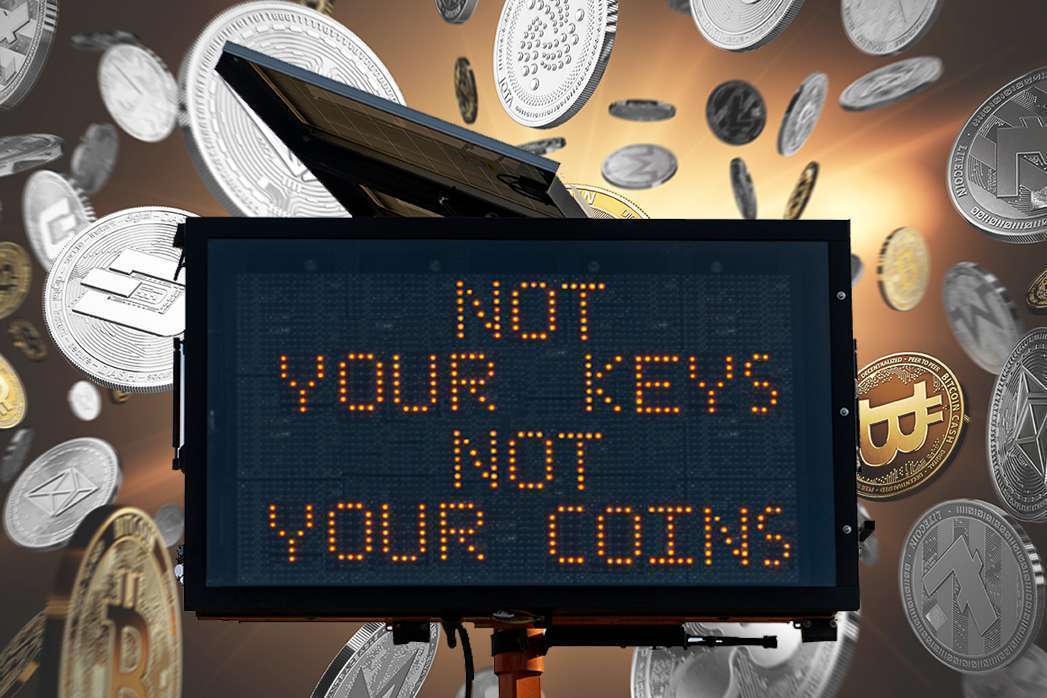
Proof of Keys is a special day in cryptography. It creates awareness for everyone around the globe to fight for their financial freedom and have control over their keys. Remember, “Not your keys, not your Bitcoin.”

Image Source: Adobe Stock

Disclaimer: This article is provided for informational purposes only. It is not offered or intended to be used as legal, tax, investment, financial, or other advice.

Read more →

An image of a businessman holding up a crypto icon.

Future Crypto payment; Cryptocurrencies in Tandem with ISO 20022

Believe it or not, there is a growing trend towards using cryptocurrencies for payments. Some experts believe that crypto could eventually be used in conjunction with ISO 20022 to facilitate secure and efficient financial transactions.

This could involve using cryptocurrency systems to transmit ISO 20022 messages between financial institutions or integrating cryptocurrency payments into existing ISO 20022-based financial processes.

To fully understand which cryptocurrencies are in the race for future payments, you must first understand ISO 20022. So, what is it?

ISO 20022

ISO 20022 is an ISO standard for the electronic exchange of data between two or more financial institutions. It describes a metadata repository hosting detailed descriptions of messages and business processes. The repository also contains its maintenance processes.

The ISO 20022 stretches to financial information transferred among different financial establishments; these include:

  • – Payment transactions.
  • – Information on all trades carried out.
  • – Securities settlement.
  • – Debit and credit card transactions, among others.


Simply put, the standard is responsible for ensuring interoperable communication between users, financial institutions, and their market establishments. One of the ways to view the ISO 20022 standard is through banks. Today, banks clash almost every time while trying to communicate with each other because they speak different “languages.”

A Real-Time Payments System. Large financial establishments, such as SWIFT, the Fed, and the ECB, aim to adopt an interbank messaging system concurrently. The financial giant SWIFT was supposed to migrate back in November last year, but decided to postpone the matter. This was similar to the ECB, pushing its migration by four months last year.

FED, via its newly launched FEDNOW program, is compatible with the previously mentioned regulation. Through FEDNOW, the United States Federal Reserve is organising a new program whose main agenda will be to meet the market needs 24 hours a day, seven days a week, all year round. Some of the features present include:

  • – Simple clearing and settling capabilities, thus supporting numerous types of transactions and usage.
  • – Utilising an ISO that has been accepted and adopted widely (ISO 20022) alongside other practices to facilitate interoperability.
  • – Use of fraud detection and prevention tools. These include configuring low transaction limits while specifying conditions under which these tools would block a transaction.
  • – Inclusion of a tool to manage liquidity. With this tool’s help, users can transfer funds amongst themselves, supporting liquidity prerequisites associated with instant and fast payments.
  • – Implementation of a receive-only system. With the system in place, financial institutions will be able to obtain payments via the FEDNOW Service without the need to have the capability to originate payments.


ISO 20022-Compliant Cryptocurrencies. Since ISO 20022 is more versatile than its predecessors, it requires significantly more data volume. Banks must be equipped to handle vast volumes of databases and process them faster to facilitate real-time payments, effective daily liquidity management, fraud detection, and compliance controls. All these need to be carried out at a significantly faster pace than banks are accustomed to, if they are to catch up with cryptocurrencies and blockchain technologies.

Some technologies are favoured more by this change in our financial system, particularly those related to cryptocurrencies. The most obvious ones are the ISO 20022-compliant cryptocurrencies. At the moment of writing this article, only seven cryptocurrencies were ISO 20022 compliant; these include:

  • Quant
  • Ripple
  • Stellar
  • Hedera
  • IOTA
  • XDC Network
  • Algorand
  • Cardano


Ultimately, 2022 has been a significant year for cryptocurrencies, and with the current market situation, now is the ideal time to make necessary adjustments. Making changes during this recession will enhance the effectiveness of these changes and establish a strong foundation for the crypto market.

Image Source: Adobe Stock

Disclaimer: This article is provided for informational purposes only. It is not intended to be used as legal, tax, investment, financial, or other professional advice.

Read more →

A person's hand holding a crypto coin.

Bitcoin Has Passed Another Milestone

According to data from the blockchain tracker, 90% of all bitcoins have been mined as of December 2021. Due to this achievement, 18.89 million bitcoins are currently traded publicly out of a possible 21 million. Since the first bitcoins were created on January 9,…

Read more →