Bitcoin myths bitcoin image on background of trueful words.

The Biggest Bitcoin Myths, Debunked

Ever since 2009 when Satoshi Nakamoto unleashed Bitcoin: A Peer-to-Peer Electronic Cash System,” his whitepaper that introduced the world to Bitcoin (BTC), it has revolutionised how people perceive money and currency; decentralised, secure, and anonymous.

“It’s a Ponzi scheme.” “It’s the currency of drug dealers and the dark web.” “It costs more to make than it’s worth.” “It’ll never go mainstream.” “It lacks stability and is subject to fluctuation.” These are just a few of the myths people tend to have about Bitcoin and other cryptocurrencies—and there’s some truth behind these statements.

Myth 1# Bitcoin Gains Aren’t Taxed

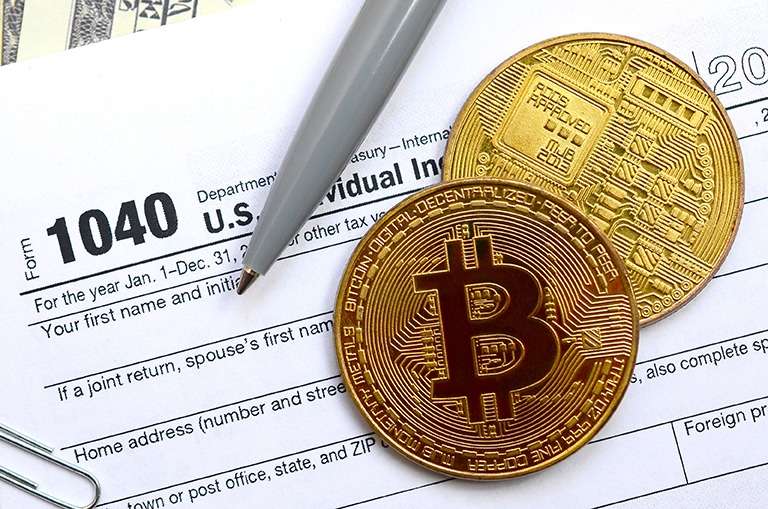
This is only partially correct. It depends on how you use your Bitcoins. Generally, if you use your Bitcoins for purchases or sales of goods or services, then any capital gains or losses are taxable events that must be reported on your tax return.

This is done regardless of whether you received cash or other property in exchange for your Bitcoins. If you hold onto Bitcoins hoping they will appreciate over time, then any capital gains are not taxed until you sell or exchange them for other property.

Myth 2# Bitcoin Is a Bubble

While it’s true that some people buy Bitcoin as investors seeking a big payout, the digital currency itself is not a bubble. Bubbles are economic cycles characterised by a rapid fall in the market.

The dot-com bubble was driven by the rapid rise of companies like Amazon and Google, which were still in their early stages when they went public. By contrast, cryptocurrencies are still relatively new, with many projects not yet ready for mass adoption or even having any real-world use cases.

Myth 3# Bitcoin Is Too Volatile to Be Useful as Money

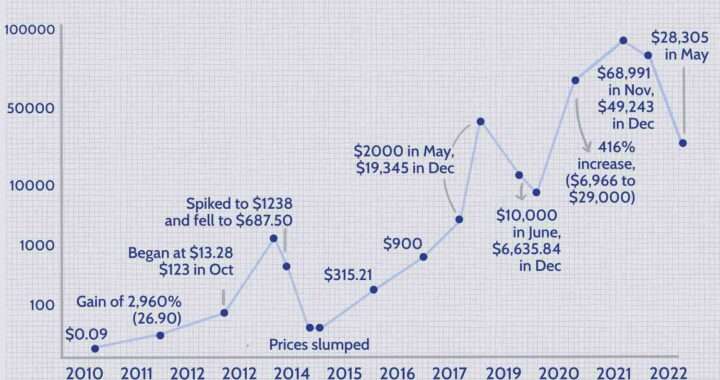
Bitcoin has proven to be highly stable compared to traditional currencies over time. But it still fluctuates widely in value relative to the dollar and other fiat currencies, such as the euro and the Japanese yen.

This volatility makes it difficult for companies to accept Bitcoin as payment without incurring a loss on every transaction. As more merchants begin accepting Bitcoin, its volatility will decrease significantly, making it a more attractive alternative currency.

Myth 4# Bitcoin Has No Real-World Uses

Critics like to claim that Bitcoin isn’t valuable in the real world and is only used by criminals. This is false. While it is true that Bitcoin can be used for illegal purchases, that’s not its primary use case.

Bitcoin is a digital currency that can be exchanged for goods and services just like any other currency. Many people are using Bitcoin to pay for everyday things like coffee or pizza at restaurants and grocery stores around the world. Even more, Airbnb allows hosts to accept payment in Bitcoin; Dish Network accepts BTC for services like satellite TV equipment installation; and the U.S. Federal Election Commission allows political donations in BTC.

Myth 5# Bitcoin Transactions Are Anonymous

Some critics claim that Bitcoin transactions are anonymous because they don’t require any personal information from users during purchase (like credit cards do). However, this is not entirely true.

When you send someone money through a cryptocurrency exchange or wallet service provider like Coinbase, they will know your public key address (a string of random numbers and letters) as well as the amount of BTC you sent.

Myth 6# Bitcoin is Bad for the Environment

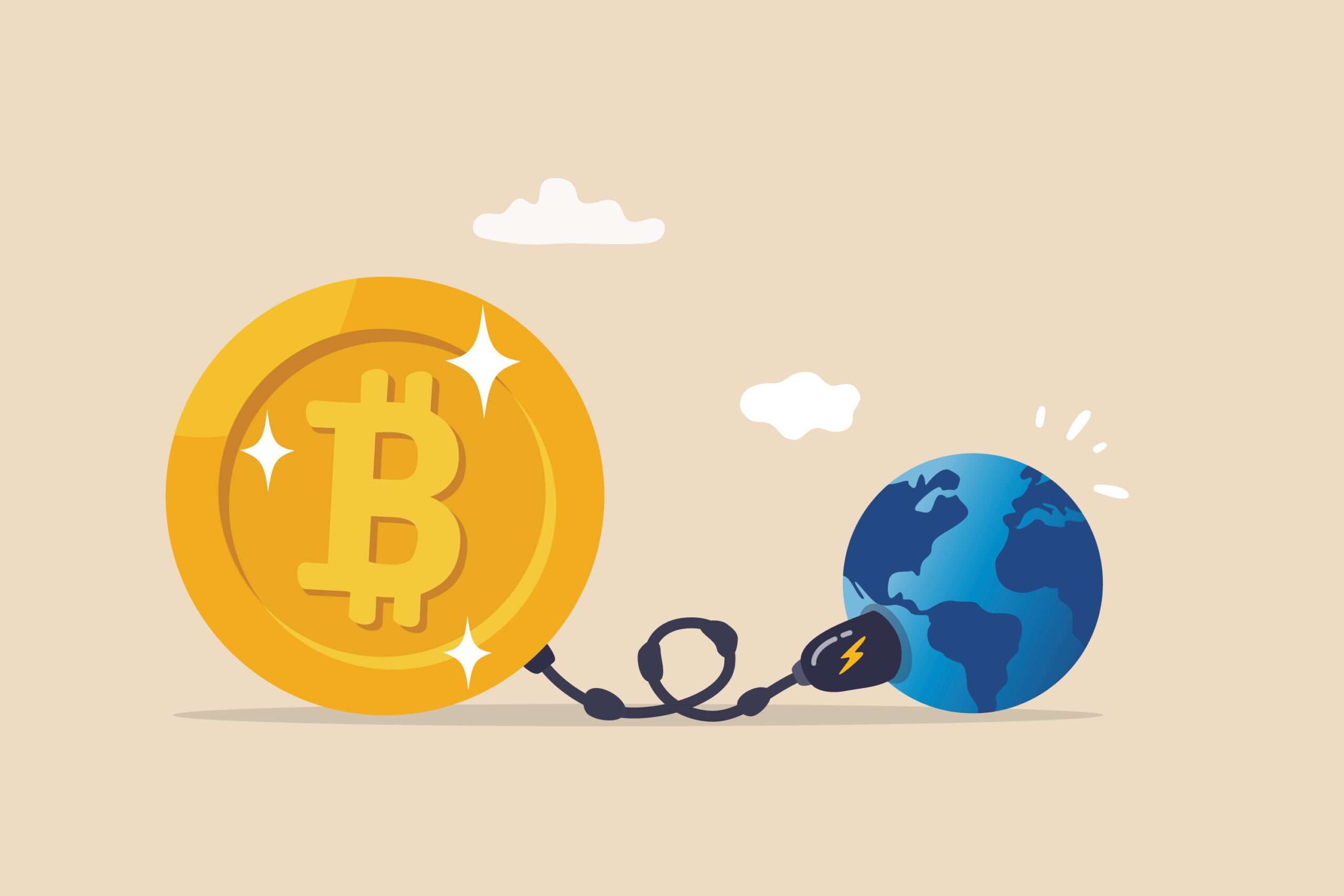
Bitcoin mining is an energy-intensive process. But determining the environmental impact is hard. For another thing, we don’t know how much energy would be used if Bitcoin didn’t exist — or if it did exist but wasn’t mined using computers.

Finally, it’s important to remember that Bitcoin mining is only one part of a larger ecosystem that includes exchanges, payment processors and users like you and me. Some people argue that these other parts are more important than mining in terms of the overall impact on global warming because they’re larger than mining operations.

Parting Shot

Despite Bitcoin being a legal currency for exchange, many countries remain hesitant to accept it. This hesitation has led to many rumours about Bitcoin’s legality. The use of Bitcoins in online transactions is already taking off and will continue to do so as its popularity increases, thus rendering these myths false. It isn’t easy to imagine that any country would be able to stop its use.

Image Source: Adobe Stock

Disclaimer: This article is provided for informational purposes only. It is not offered or intended to be used as legal, tax, investment, financial, or other advice.


Read more →

A blue background with a bitcoin symbol, highlighting its connection to the blockchain genesis block.

Bitcoin’s 14th Anniversary: Looking Back at The Genesis Block

January 2023 marks the 14th anniversary of the creation of Bitcoin’s Genesis block by Satoshi Nakamoto. January 3, also known as Proof of Keys day, helps us reflect on the life of the Genesis block and Bitcoin.

In 2009, Satoshi Nakamoto created the first cryptographic block, the Genesis block. Its creation ushered in a series of dominoes, giving birth to an entirely new movement. Nakamoto’s creation has been recreated several times since 2009, and over the years, the aim of the Genesis block has become more definitive than ever.

The Chancellor of the Exchequer, on the brink of the second bailout for banks, is conceivably the most famous phrase concerning the Genesis block. Aside from its deeper philosophical meaning, the term stands for what Bitcoin set out to oppose. The manifesto presented by the Bitcoin movement against the centralised financial system was simple: to give people, us, economic freedom.

Bitcoin seeks to overthrow the existing financial system used by banks, which is a monetary system that Banks or governments can manipulate to benefit an entitled group of people. With Bitcoin, the playing field was levelled. Everyone now has the same opportunities irrespective of race, gender, political affiliation, or religion.

Bitcoin’s dream was realised due to its core values and characteristics. Since the software’s protocol was run and thoroughly executed by nodes around the globe, Bitcoin enabled us to attain financial freedom.

Since its inception, the number of Bitcoin-related activities has grown exponentially. However, this comes at a disadvantage. Some of the core principles that were Bitcoin’s stepping stone are now being ignored or forgotten. Activities such as buying, selling, withdrawing, and custody services have centralised the franchise.

On the brighter side, though, this somewhat centralisation has made the industry face less opposition.

Despite Bitcoin holders having several requirements to meet to detach themselves from a centralised system altogether, we also want to briefly examine the Proof of Keys day.

Proof of Keys

The event celebrated annually has the same birthday as the Genesis block. It was started by Trace Mayor and featured BTC users withdrawing their BTC from companies in mass. Tracer said this was to ensure that these institutions weren’t practising centralised financial methods.

Another critical aspect to consider as we celebrate the Genesis block is the “keys.” Essentially, there are two types of private and public keys. However, we’ll focus more on private keys. As the name suggests, private keys are the only way to spend the BTC in your wallet. With them, you can access or spend your BTC. This is because, on every BTC transaction, the sender places a “lock” on the Bitcoins loaded with the user’s information. Thanks to asymmetric cryptography, only the receiver can access these BTC, which also possess their keys. This, therefore, means that only the receiver influences their Bitcoins.

However, if you have a third-party firm storing the Bitcoin for you, they possess your private keys. Therefore, no special permission is required to move your BTC. In most cases, this process is automated. Nonetheless, it is still essential to enable you to move your Bitcoins, primarily through processes such as withdrawal requests.

In Conclusion

Proof of Keys is a special day in cryptography. It creates awareness for everyone around the globe to fight for their financial freedom and have control over their keys. Remember, “Not your keys, not your Bitcoin.”

Image Source: Adobe Stock

Disclaimer: This article is provided for informational purposes only. It is not offered or intended to be used as legal, tax, investment, financial, or other advice.

Read more →

A person's hand holding a crypto coin.

Bitcoin Has Passed Another Milestone

According to data from the blockchain tracker, 90% of all bitcoins have been mined as of December 2021. Due to this achievement, 18.89 million bitcoins are currently traded publicly out of a possible 21 million. Since the first bitcoins were created on January 9,…

Read more →

A crypto Bitcoin sits on top of a stack of dollars.

The Value of Bitcoin in The Future

Bitcoin is the world’s first and most successful crypto asset. Since its inauguration, Bitcoin has made history, especially regarding its price. Everyone didn’t expect the asset’s value acquired during the bullish 2021. In April last year, the value of the asset was $64,000 (£52,000)….

Read more →

A stack of bitcoins in front of the mt Gox logo showcasing the power of ukcrypto.

Mt Gox Bitcoin Release and Payout Date

The once renowned Bitcoin exchange firm-Mt Gox has announced that it is ready to pay its investors a total of 141,000 Bitcoins indebted to them. For those unfamiliar with Mt. Gox, it was a Japanese exchange firm smeared with lies, hacks, and scams. During…

Read more →

Bitcoin Falling Apart To Digits

BTC Withdrawals Hit Record-Breaking Volume

The Bitcoin market is moving up, and by the looks of it, the bulls are back. On September 30, nearly 34,700 Bitcoins, worth approximately $668 million, were withdrawn from exchanges. The recent movement of Bitcoin from exchanges is a sign that traders are confident in the cryptocurrency’s future. Traders may be bullish on BTC heading into the fourth quarter of 2022.

CryptoQuant reports that Bitcoin has been steadily losing exchange reserves in the last three days. The 60,000 BTC pulled out of exchanges within this period ranks as the highest amount of Bitcoin withdrawn in months, heralding a return of buyers who have been absent for many months. This is excellent news for traders holding a significant position in BTC, as it means more liquidity than ever before.

A rally in cryptocurrency values can be attributed to the massive movement of coins from crypto exchanges. Historically, a significant movement of assets from crypto exchanges has led to increased asset value. The last time large amounts of Bitcoin were withdrawn from the exchange, its price jumped by 22%. More than 60% of the bitcoin supply has been removed from the market, leading to prominent traders and investors speculating on a bullish rally. When the market is besieged with net positive BTC exchange outflows, it suggests that investors are becoming more comfortable with the prospect of holding their assets.

Over the last few months, Bitcoin’s value has remained above $19,000, a critical threshold for the cryptocurrency’s recovery. If Bitcoin remains above this level and continues to rise, it will likely be able to reach $ 30,000 or higher in the future. If this happens, traders may revisit the support at $18,210. However, if the current trend is maintained and investors continue to sell their Bitcoins, the value of BTC might fall back.

In the past, the current wave was considered the final stage of the Bitcoin bear market, during which traders sold their BTC in massive quantities. However, there have been signs that the industry may be on the verge of recovery. Inflow, SOAB, has shown that between April 2021 and April 2022, investors purchased Bitcoin at prices above $30,000 and then sold it at a loss of nearly 50%. This suggests that the bottom of the cycle is near, and Bitcoin is poised to rebound.

Most analysts believe that the recent Bitcoin pullback is due to a large number of coins being moved, which could have been done to rebalance ledgers. Some people also presume that Bitcoin is in a bubble, and there is no doubt about it. However, it’s a bubble that will not burst anytime soon.

Typically, one of the most exciting aspects of the cryptocurrency market is its incredible volatility. The price of a cryptocurrency can change drastically within a few hours, even minutes. That is why keeping an eye on crucial indicators and warnings when trading cryptocurrencies is essential.
What is the future of BTC?

Image Source: Adobe Stock

Disclaimer: This article is provided for informational purposes only. It is not offered or intended to be used as legal, tax, investment, financial, or other advice.
Read more →