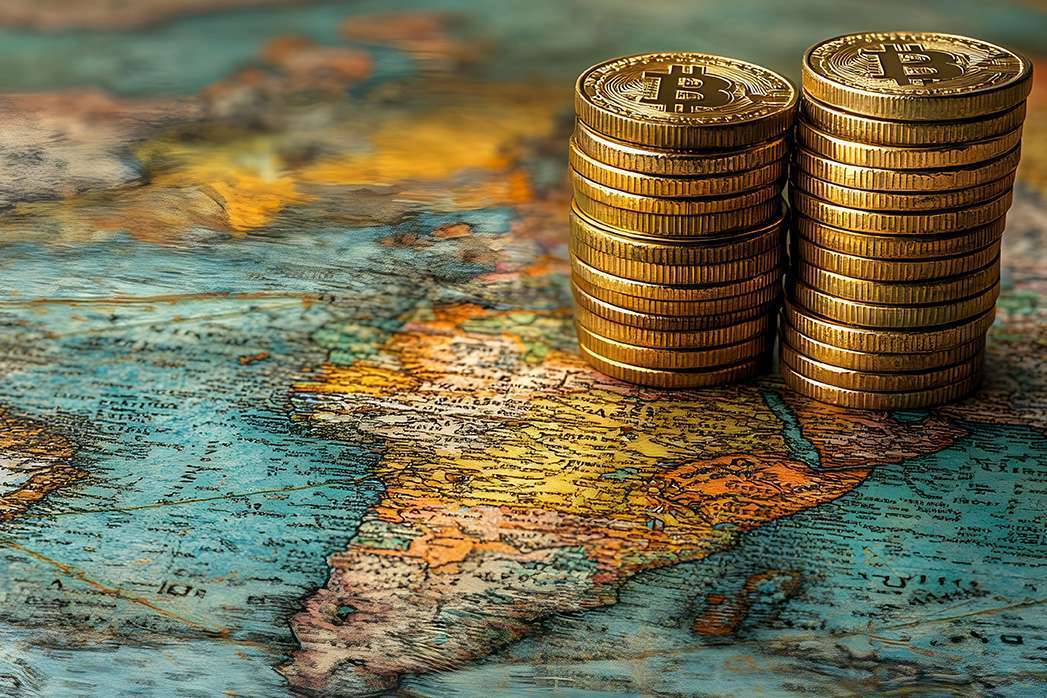

Global Crypto Stacks on Vintage Map.

Global Trade Wars: The Battle Over Bitcoin Reserves

If you have been around long enough, you know how countries have fought for gold, oil, and land for centuries. Wars have been waged, deals have been made, and fortunes have been won. But here’s the plot twist, the war today is virtual and Bitcoin is the price.

At its infancy, Bitcoin seemed like a niche invention and just another way of buying things online. However, it has tremendously developed. It is a tool that can shift financial power, challenge the banking system, and even reshape global politics. We can safely call it a disruptor.

Some governments are quietly buying it. Others are banning it outright. Either way, Bitcoin is now at the centre of economic conflicts, especially on matters of sanctions and financial control.

So why does Bitcoin matter so much? And what happens when governments start treating it like a weapon?

Why Bitcoin is Different

Bitcoin isn’t like regular money. First, it’s limited—there can only ever be 21 million Bitcoins available. No one can print extra, no matter how much they might want to.

Also, it doesn’t rely on banks. With traditional money, banks and governments control transactions. They can freeze accounts, block payments, and decide who can access their system. Bitcoin is different. It allows people to send and receive money directly without any institution’s approval.

And here’s the real game-changer: Bitcoin is borderless. You can send it anywhere in the world without asking for permission. That makes it especially useful in places with strict financial rules or economic sanctions.

Some governments see this as a threat. Others see an opportunity…

China: From Leader to Crackdown

For years, China dominated Bitcoin mining, producing more than half of the world’s supply. Then, in 2021, the government suddenly banned it. Mining companies shut down overnight or moved elsewhere.

At first, it seemed like China wanted nothing to do with Bitcoin. However, some believe the government still holds large amounts of it, possibly as a hedge against the global financial system. At the same time, China has been pushing its digital currency—the digital yuan—which it fully controls. Unlike Bitcoin, this currency gives the government total oversight of every transaction.

Europe: Optimism and Regulatory Challenges

Europe received Bitcoin with mixed reactions. Where institutional investors and fintech companies are eager and willing to take a deep dive into this digital asset, on the other side, regulators remain cautious, with some sharing the same sentiments, eyeing the benefits of Bitcoin. Contrastingly, other policymakers fear for the euro and the overall financial stability of the EU.

China’s crackdown opened doors for other parts of the world and parts of Europe with favourable energy policies. However, with the current dynamics and stringent regulations, it remains to be seen whether regulations and evolving EU legislation could determine the future of Bitcoin in the region.

What’s Next?

Bitcoin’s part in global power conflicts is only becoming larger. Some countries will start buying Bitcoin and hand-holding it like they do gold—a reserve asset in case traditional currencies fail. At the same time, governments will try to regulate it more to control its use.

Government-backed digital currencies will continue to surface, giving governments more control of financial networks and competing with Bitcoin. Bitcoin is changing money all over the world. Some countries see it as a threat to their power. Others see it as the future.

As of March 2025, several countries have accumulated significant Bitcoin reserves through various means, including asset seizures, mining operations, and strategic investments. The following is an overview of notable national Bitcoin holdings:​

 
Country Estimated Bitcoin Holdings Approximate USD Value (March 2025) Acquisition Method
United States
207,189 BTC
$17.6 billion
Primarily through asset seizures related to criminal investigations.
China
194,000 BTC
$16.5 billion
Mainly acquired via confiscations from illicit activities.
United Kingdom
61,000 BTC
$5.2 billion
Obtained through law enforcement seizures.
Ukraine
46,351 BTC
$3.9 billion
Accumulated through various governmental initiatives.
Bhutan
13,029 BTC
$1.1 billion
Generated via state-run hydroelectric-powered mining operations.
El Salvador
6,003 BTC
$510 million
Purchased as part of a national strategy to adopt Bitcoin as legal tender.
North Korea
13,580 BTC
£886 million (approximately $1.1 billion)
Accumulated largely through cyber-hacking activities conducted by the Lazarus Group.

These developments reflect a growing trend among nations to explore and, in some cases, adopt Bitcoin as part of their financial strategies, each influenced by unique economic, technological, and geopolitical factors.

The question is: Will Bitcoin be the world’s future monetary standard, or can governments stop it? One thing is certain: the fight over Bitcoin has only just begun.

Image Source: Adobe Stock

Disclaimer: This article is purely for informational purposes. It is not offered or intended to be used for legal, tax, investment or financial advice.


Read more →

finance, BTC, crypto and stock prices and chart showing stock market

What Are Over-the-counter (OTC) Derivatives?

Over-the-counter derivatives are financial instruments that receive their value through direct private agreements between market participants instead of through traditional exchange marketplaces. Exchange-traded instruments differ from these contracts as OTC derivatives receive private negotiation treatments between counterparties, allowing them to customise their terms. The…
Read more →

Bitcoin ETF on black background.

Why Are Institutions Buying Spot Bitcoin ETFs?

2024 has seen major institutional players, including hedge funds, banks, and pension funds, show a growing appetite for spot Bitcoin ETFs. This trend cements the significance of the shift and the wider acceptance of Cryptocurrency investments among investors.  Big players like Morgan Stanley have invested heavily…

Read more →

Bitcoin on a gold exploding background that no one can control Bitcoin and it's going to explode in 2024 to the mainstream.

Why Nobody Can Control Bitcoin

In finance, where centralization and regulation have long been the norm, Bitcoin emerged as a disruptive force, challenging the established order. Since its inception in 2009 by the character Satoshi Nakamoto, Bitcoin has grown into a global phenomenon, captivating the imagination of individuals, investors, and institutions…
Read more →

Bitcoin's fundamental value lies in its basis as sound money, a significant factor propelling it towards becoming the future currency

Bitcoin: The Sound Money for Future Society

In the evolving world of digital and decentralized finance, Bitcoin, the first cryptocurrency, has played an instrumental role. Lauded for its potential to democratize finance, Bitcoin’s fundamental value lies in its basis as sound money, a significant factor propelling it towards becoming the future currency. Sound money,…
Read more →

Recession Fears Loom in 2024: Will Bitcoin or Gold Prevail as the Ultimate Safe Haven?

Bitcoin or Gold in 2024?

The looming economic recession in 2024 will be unlike any financial crisis in recent times. Uncertainty is swarming the world economy. Investors are hurrying to find safe havens. On the other hand, Gold and Bitcoin are the two major players in this rush.  Through many market crises,…
Read more →