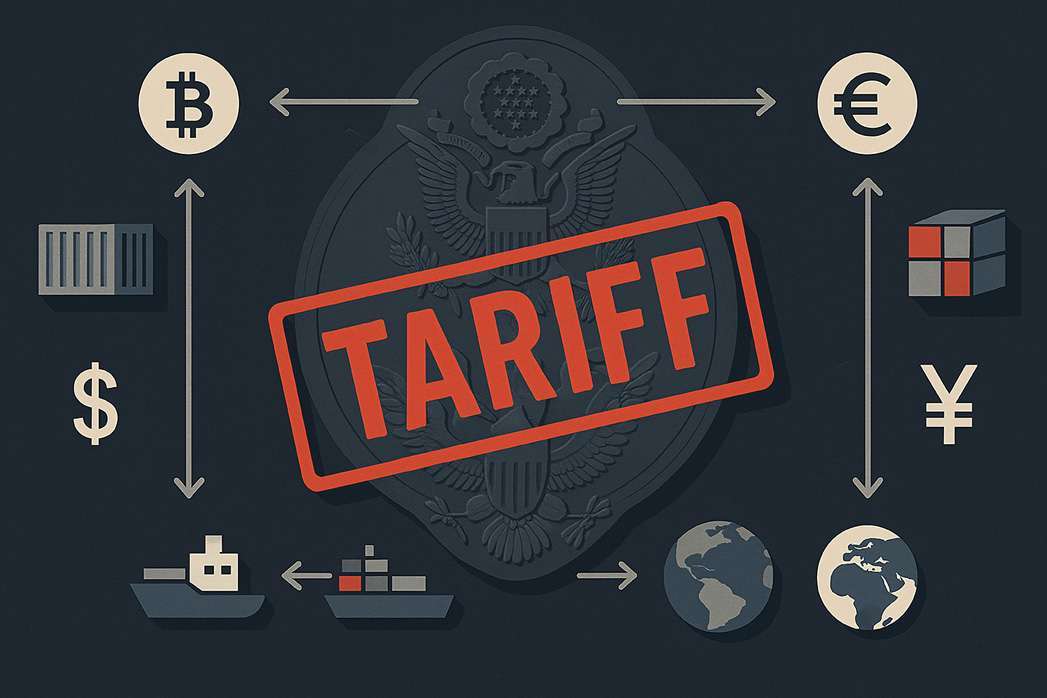
Global Tariff Impact on International Trade and Currencies.

Bitcoin in a Tariff-Tangled World: A Neutral Asset for Uncertain Times

When If countries start imposing tariffs on each other, markets get jittery. Global trade flows twist, fiat currencies do a little nervous dance, and investors start asking that age-old question: Where’s safe?

Traditionally, the answer might have been gold, government bonds, or a strong, stable currency like the US dollar. But in an increasingly unpredictable, tariff-happy world, a new contender is quietly sliding into the ring — one that doesn’t belong to any nation, isn’t tied to any economy, and never needs a passport: Bitcoin.

Tariffs, Tantrums and Tumbling Trust

Tariffs are essentially taxes on imports. Sometimes, they’re about safeguarding local jobs; other times, they’re just geopolitics flexing its muscles. But like most economic tools wielded under pressure, tariffs tend to come with unintended consequences.

Slap tariffs on another country’s goods, and they’re likely to retaliate. Before you know it, prices are rising, supply chains are tangling, and everyone’s central bank is stress-baking spreadsheets.

“The U.S. is considering new tariffs on Chinese electric vehicles and batteries, raising fresh concerns over a resurgence in trade tensions.”
Reuters, April 2024

Fiat currencies can feel the heat fast because they are deeply tied to their respective national economies. Especially in emerging markets, currency volatility often follows trade tensions like a moody shadow.

“Emerging market currencies have experienced their worst quarter since the pandemic, largely due to fears around global tariffs and slowing trade.”
Bloomberg, Q1 2024

This environment is like trying to play chess during an earthquake for investors. It’s no wonder they start looking beyond borders.

Bitcoin: The Stateless Safe Haven?

Bitcoin doesn’t care about your tariffs. Or your inflation. Or your three-hour-long trade negotiations. It runs on its network, unaffected by geopolitical drama — a feature, not a bug.

This neutrality makes Bitcoin appealing in a world where traditional financial systems feel the strain of nationalist policies. Bitcoin isn’t pegged to any government. It doesn’t rely on central bank decisions. And its supply is famously capped, meaning it can’t be inflated on a whim.

“We’re seeing more institutional interest in Bitcoin as a macro hedge — not instead of gold, but alongside it.”
Rick Rieder, CIO, BlackRock, January 2024

In other words, while the moods of their mother countries drag fiat currencies along, Bitcoin just keeps humming along in the background: decentralised, transparent, and blissfully indifferent.

Bitcoin in the Real World

This isn’t just crypto daydreaming. We’ve already seen hints of Bitcoin playing the safe-haven role in the wild.

The 2019 trade wars between the US and China led to Bitcoin’s price movements and echoed tensions in the Yuan and US dollar, suggesting that investors were at least toying with the idea of Bitcoin as a hedge.

More recently, with tariff threats re-emerging and uncertainty swirling around global supply chains, Bitcoin’s narrative as “digital gold” is gaining traction again.

“Bitcoin surged past $70,000 in March 2024 amid rising geopolitical tensions and renewed interest in non-sovereign stores of value.”
CoinDesk, March 2024

“In times of economic or political stress, Bitcoin often behaves more like digital gold than a tech stock.”
JPMorgan Global Markets Strategy Note, February 2024

Unlike gold, though, it’s easier to store, move, and verify, which, in a digitised world, is more than just a bonus.

The Caveats

Now, let’s not get carried away. Bitcoin is still volatile. It’s also not universally adopted nor fully understood by most investors.

And unlike traditional hedges, Bitcoin’s correlation to major market moves isn’t always consistent. Sometimes, it behaves like a risk asset; sometimes like a haven; and occasionally, like a sleepy cat who does what it wants, when it wants.

Still, in a landscape shaped by tariffs and shifting alliances, having a tool outside the usual systems is worth considering. Especially one that’s proven it can operate and thrive on its terms.

“Tariffs and protectionist policies are leading companies to rethink global supply chains, a trend that’s driving capital into decentralized and digital assets.”
The Economist, April 2024

As governments joust with trade policies and fiat currencies sway in the breeze of uncertainty, Bitcoin is quietly making its case.

It’s not perfect—it’s not even fully mature—but it is neutral, borderless, and resistant to the whims of any single economy. And in today’s tangled global web, that’s starting to look less like a novelty and more like a necessity.

Image Source: Adobe Stock

Disclaimer: This article is purely for informational purposes. It is not offered or intended to be used for legal, tax, investment or financial advice.


Read more →

Happy man winning with bitcoin, holder earns money.

Top Bitcoin Holders in 2025

Bitcoin remains the most valuable and well-known cryptocurrency in the world. Despite its reputation for decentralization, large holders — known as “whales“—including individuals, corporations, governments, and funds—control substantial amounts of BTC.

But who holds the most Bitcoin in 2025, and why does it matter?

Who Are Bitcoin Whales?

Bitcoin’s total supply is capped at 21 million coins. As of April 2025, about 19.6 million BTC were in circulation. Whales are entities—whether individuals, companies, or governments—that hold a disproportionately large amount of Bitcoin. Their influence on the market is significant due to their ability to drive or dampen price action through major trades.

Moreover, whales impact liquidity — the ability to buy or sell Bitcoin without significant price fluctuations. Deep-pocketed holders contribute to a more stable market through large buy and sell orders, although their actions can also cause short-term volatility.

Nikita Buzov, CEO and Founder of Solace, commented:

“Understanding the flow of liquidity and where it is positioned allows one to read sentiment, predict price movements, and anticipate imminent large-scale liquidations.”

Who Owns the Most Bitcoin in 2025?

According to the most recent data:

Satoshi Nakamoto

Still the largest known BTC holder, the anonymous Bitcoin creator is estimated to hold approximately 1.1 million BTC across more than 22,000 addresses—untouched since its creation.

BlackRock (iShares Bitcoin Trust – IBIT)

BlackRock now holds over 350,000 BTC through its ETF and is on track to overtake Satoshi as the largest BTC holder by late 2025.

MicroStrategy

Led by Bitcoin advocate Michael Saylor, MicroStrategy now holds around 461,000 BTC as of Q1 2025, at an average price of $63,610 per coin.

Binance

The world’s largest crypto exchange reportedly controls around 550,000 BTC across multiple wallets.

United States Government

The U.S. government holds approximately 213,246 BTC, largely acquired through asset seizures.

China and North Korea

China holds around 190,000 BTC, while North Korea — through cyber-hacking units such as the Lazarus Group — holds an estimated 13,580 BTC, reportedly used to fund state programs.

Grayscale and Fidelity

Grayscale’s GBTC trust holds roughly $20.6 billion in BTC, while Fidelity’s FBTC fund manages about $18.4 billion in assets.

5 Largest Individual Bitcoin Billionaires (2025)

  • Satoshi Nakamoto – 1.1M BTC (unmoved)
  • Michael Saylor – Over 17,000 BTC personally, plus 461,000 BTC via MicroStrategy
  • Brian Armstrong – CEO of Coinbase
  • Changpeng Zhao (CZ) – Former CEO of Binance
  • Tim Draper – Acquired 30,000 BTC via U.S. government auction


Biggest Celebrity Bitcoin Owners (Updated for 2025)

  • Elon Musk – Still holds Bitcoin as part of personal and Tesla holdings
  • Jack Dorsey – Continues to be a vocal Bitcoin maximalist
  • Mike Tyson – Early advocate, still involved in crypto ventures
  • Maisie Williams, Snoop Dogg, Kanye West – Publicly declared their BTC holdings


Top 10 Companies Holding the Most BTC (2025)

  1. MicroStrategy – 461,000 BTC
  2. Tesla – 9,720 BTC
  3. Robinhood – 136,755 BTC
  4. Marathon Digital Holdings
  5. Galaxy Digital Holdings
  6. Hut 8 Mining
  7. Coinbase (Treasury Holdings)
  8. Square (Block, Inc.)
  9. Voyager Digital
  10. Bit Digital Inc.

Top 5 Crypto Exchanges Holding BTC (2025)

  1. Binance – 550,000 BTC
  2. Bitfinex – 180,000 BTC
  3. OKX – 62,000 BTC
  4. Crypto.com – 24,000 BTC
  5. BitMEX – 13,000 BTC

Note: These figures may fluctuate as exchanges manage hot/cold wallets and custodial services.

Which Countries Hold the Most Bitcoin?

  • United States – Leading with over 213,000 BTC in government reserves
  • China – Estimated at 190,000 BTC
  • North Korea – Holds 13,580 BTC
  • El Salvador – Continues to purchase BTC for national reserves
  • Central African Republic – Maintains BTC as legal tender

In a significant shift, the U.S. has launched a Strategic Bitcoin Reserve, similar to its strategic oil reserves, signalling Bitcoin’s rising importance as a national asset.

Why This Matters

Bitcoin’s supply is fixed. Knowing where large portions are held reveals necessary market behaviour, liquidity, and decentralization dynamics. Whether it’s institutional funds like BlackRock or nation-states like the U.S., consolidating BTC into fewer hands may contradict Bitcoin’s decentralized ideal — but it also signifies growing mainstream and governmental confidence.

Image Source: Adobe Stock

Disclaimer: This article is provided for informational purposes only. It is not offered or intended to be used for legal, tax, investment or financial advice.

Read more →

A digital world map with Bitcoin symbols highlighting global adoption, various continents illuminated, symbolizing the widespread impact of cryptocurrency.

Global Bitcoin Ownership at 4%: Adoption Just Beginning

A recent Bitcoin analytics firm, River Financial, reports that Bitcoin ownership resides with less than 4% of the world population. The data suggests that Bitcoin possesses vast development potential and adoption rates throughout wealthy regions.

The report shows that Bitcoin adoption has only reached 3% of its theoretical full potential at the time of writing. It is just beginning since its current state is comparable to the early Internet adoption in 1990.

Bitcoin Adoption: Regional Disparities and the Potential for Growth

The study shows significant differences in Bitcoin possession quantity between different geographic areas, tending to be highest in North America, where ownership reaches 14% and with only 1% ownership in Africa.

The study does not specify Europe’s position directly, but data indicates a heavy adoption, especially with the new MiCA-friendly regulations. This pattern reflects a broader trend: Bitcoin adoption is higher in wealthier areas where financial literacy, digital infrastructure and access to Cryptocurrency platforms are more advanced.

Global Bitcoin adoption stands to gain momentum based on the report’s recommendations, which rely on institutional and government-backed initiatives. Bitcoin holds approximately 0.5% of worldwide assets alongside extremely low institutional investment.

Barriers to Adoption

Multiple obstacles prevent Bitcoin adoption, with a lack of knowledge and concerns about secure platform acquisition being the most significant issues. Sequentially, Bitcoin adoption continues to face resistance as some people do not understand its value, and others doubt its validity because of how volatile it is and the speculation around trading this asset class. Crypto adoption rates are slow in areas that do not provide adequate financial awareness.

However, this is changing. Expanding digital asset infrastructure and increased availability of trustworthy Bitcoin trading platforms will further drive its adoption. Bitcoin ETFs continue to rise while governments and regulators provide more clarity and movements, strengthening this trajectory.

“The biggest hurdle for Bitcoin is education. Once people understand its value proposition, adoption is inevitable.”Andreas Antonopoulos, Bitcoin advocate and author

Europe’s Role in the Bitcoin Adoption Curve

With substantial financial systems and a tech-savvy population, Europe is well-positioned to lead Bitcoin adoption. The recent push for regulatory frameworks, such as the Markets in Crypto-Assets (MiCA) regulation, aims to provide clarity and security for investors, thus creating a more stable environment for Bitcoin growth.

While Bitcoin adoption in Europe is still in its early stages, increasing institutional involvement and public awareness could push the region towards greater integration of digital assets into mainstream finance.

“With regulatory clarity, Europe has the chance to become a global leader in digital assets.”Christine Lagarde, President of the European Central Bank

The Take Home

The report stipulates that with only 4% of the global population owning Bitcoin and institutions largely underinvested, Bitcoin is still in its infancy. However, the growth potential is immense. As crypto financial literacy advances, digital asset accessibility increases, and institutional investments rise, Bitcoin adoption will surely accelerate across the globe.

In Europe, the coming years are vital for determining whether the region will lead the next wave of financial innovation or watch from the sidelines as others drive Bitcoin’s mainstream adoption forward.

Image Source: Adobe Stock

Disclaimer: This article is purely for informational purposes. It is not offered or intended to be used for legal, tax, investment or financial advice.

Read more →

Blue digital miner with a pickaxe and a bitcoin. Concept of bitcoin mining.

The Top Bitcoin Mining Software in 2024

For almost two decades, Bitcoin has undoubtedly sealed its place as the market leader when it comes to Cryptocurrency. But hey, have you ever wondered how new Bitcoins are made? Do you want to start Bitcoin mining? Then this write-up takes you through a…

Read more →