Bitcoin breaking the chain

Custody Is the New Monetary Policy

“Markets are shaped long before trades hit an exchange.” DNA Crypto.

Why Custody Now Shapes the Market

For years, custody was framed as a defensive function. Safekeeping. Cold storage. Security.

That framing is outdated.

Custody decisions now influence how Bitcoin behaves across the market. They affect liquidity, velocity, and leverage in ways that resemble monetary policy more than asset storage.

The market is shaped upstream, not on exchanges.

Control of Keys Is Control of Behaviour

Whoever controls the keys controls whether Bitcoin can be moved, settled, or reused.

Custody determines:

  • – How quickly assets can be deployed
  • – Whether Bitcoin can be used as collateral
  • – How much leverage exists in the system

This is why custody increasingly appears alongside liquidity analysis in articles such as Markets Price Liquidity.

Custody Decisions Affect Velocity

Velocity is not just a function of demand. It is a function of access.

Bitcoin held in deep cold storage behaves differently from Bitcoin held in operational custody. One reduces the circulating velocity. The other amplifies it.

As Bitcoin migrates into institutional custody frameworks, velocity becomes engineered rather than emergent.

This dynamic is visible in Bitcoin Liquidity Squeeze.

Rehypothecation Is a Policy Choice

Rehypothecation is not inherently good or bad. It is a design decision.

Custody structures determine whether Bitcoin can be:

  • – Lent
  • – Used as collateral
  • – Reused across multiple obligations

Each layer of reuse increases liquidity but also systemic risk. This mirrors traditional monetary systems in which credit creation expands the money supply without altering base assets.

The parallel is explored in Bitcoin as Collateral.

Liquidity Access Is the New Constraint

Bitcoin’s fixed supply does not guarantee liquidity.

Access constraints can freeze assets through:

  • – Custody terms
  • – Jurisdictional restrictions
  • – Operational or compliance holds

When this happens, effective supply contracts are available regardless of price. This access fragility is analysed in The Real Counterparty Risk in Bitcoin Is Access.

Institutional Custody Quietly Changes Bitcoin

As Bitcoin enters institutional custody, its behaviour shifts.

Long-duration holding increases. Trading supply shrinks. Liquidity becomes episodic rather than continuous.

This is why Bitcoin’s market dynamics increasingly resemble those of balance-sheet assets rather than speculative instruments, as described in Bitcoin as Financial Infrastructure.

Why This Feels Like Monetary Policy

Monetary policy works by influencing:

  • – Availability of capital
  • – Cost of leverage
  • – Speed of settlement

Modern custody frameworks do the same, without headlines or announcements. Control shifts gradually, quietly, and structurally.

Bitcoin remains decentralised at the protocol level. Its market behaviour is increasingly shaped by custody architecture.

A Structural Conclusion

Bitcoin’s future will not be decided solely by price or protocol upgrades.

It will be shaped by who controls access, velocity, and reuse of capital.

Custody has become the silent policy layer.

Those who understand this are not watching exchanges.
They are designing custody.

Relevant DNA Crypto Articles

Image Source: Adobe Stock
Disclaimer: This article is for informational purposes only and does not constitute investment, legal, or tax advice.
Register today at DNACrypto.co

Read more →

The Bitcoin Liquidity Illusion.

The Bitcoin Liquidity Illusion

“Liquidity disappears before price reacts.” DNA Crypto.

The Assumption That Breaks First

Most market participants assume that the visible Bitcoin supply is the available supply. It is not. On-chain supply statistics create a comforting illusion. They suggest abundance, depth, and optionality. In reality, liquidity is conditional, and those conditions fail long before price discovery catches up. This gap between visible supply and usable supply is where most market shocks begin.

On-Chain Supply Is Not Tradable Supply

Bitcoin’s circulating supply includes coins that will never trade in stressed conditions.

  • – Coins held by long-term holders with no price sensitivity
  • – Coins locked in custody structures with access constraints
  • – Coins held by entities that cannot or will not sell under pressure

These coins exist on-chain, but they do not participate in price formation when liquidity is most important. This structural mismatch underpins the liquidity dynamics explored in Bitcoin Liquidity Squeeze.

Custodied Bitcoin Is Often Illiquid Bitcoin

Custody adds another layer to the illusion. Bitcoin held in custodial structures may be secure, but security does not equal liquidity. Access can break due to:

  • – Platform withdrawal limits
  • – Operational downtime
  • – Jurisdictional or compliance holds
  • – Policy or risk management freezes

When this happens, Bitcoin becomes economically inert. It exists, but it cannot respond. This access fragility is analysed in The Real Counterparty Risk in Bitcoin Is Access.

Long-Term Holders Change Market Behaviour Permanently

Long-term holders are not passive participants. They reshape the market. As Bitcoin migrates into treasuries, family offices, and strategic reserves, it exits the tradable pool. These holders do not respond to short-term volatility. Their behaviour introduces structural supply inelasticity. This is why Bitcoin’s market behaves differently from traditional assets, a theme developed further in Bitcoin Outlasted the Opposition.

Liquidity Vanishes Before Price Moves

In stressed markets, prices do not move because liquidity is thin. Price moves because liquidity has already disappeared. Order books hollow out. Spreads widen. Execution risk explodes. Only after liquidity collapses does the price adjust. This sequencing is why traders often feel “trapped” even when the price appears rational—markets price liquidity first, a principle detailed in Markets Price Liquidity.

Why Traders and Institutions See Different Markets

Traders see volatility. Institutions see liquidity reliability. For institutions, the relevant question is not whether Bitcoin can be sold, but whether it can be sold at size, under stress, and within policy constraints. This explains why institutional frameworks prioritise custody design and access planning, as discussed in Bitcoin Custody and Continuity.

The Illusion Becomes a Shock

Liquidity illusions persist until they fail. When they do, markets reprice violently, not because fundamentals changed, but because assumed liquidity was never there. This dynamic is central to the risk described in Why Dependency, Not Volatility, Is the Biggest Financial Risk.

What Serious Investors Do Differently

Professional investors design around liquidity fragility. They focus on:

  • – Access certainty, not just custody
  • – Multiple execution pathways
  • – Jurisdictional diversification
  • – Realistic assumptions about tradable supply

Bitcoin becomes safer not when volatility declines, but when liquidity assumptions are realistic.

A Reference-Grade Conclusion

Bitcoin’s greatest market risk is not volatility. It is the illusion that supply equals liquidity. Understanding this distinction clarifies the distinction between trading narratives and institutional reality and explains why Bitcoin continues to surprise markets even after fifteen years.

Relevant DNA Crypto Articles

Image Source: Adobe Stock
Disclaimer: This article is for informational purposes only and does not constitute investment, legal, or tax advice. Register today at DNACrypto.co

Read more →

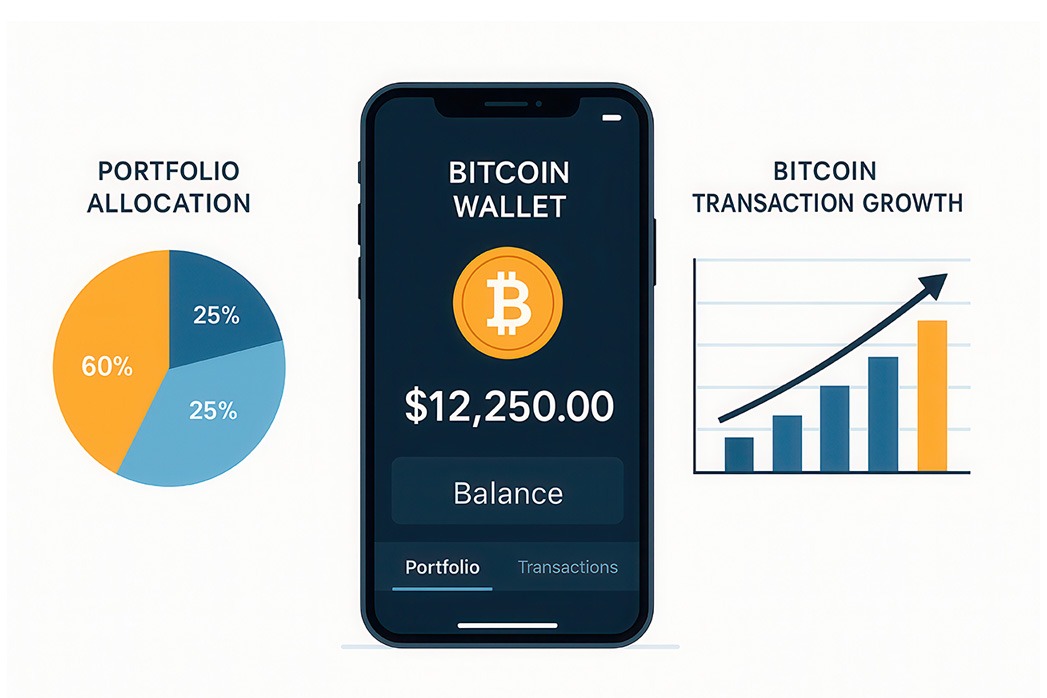
Bitcoin wallet mockup showcasing crypto portfolio allocation and transaction growth in a digital environment.

Bitcoin Is No Longer a Trade. It Is a Balance Sheet Decision.

“Bitcoin stopped being a trade when institutions started asking where it sits on the balance sheet.” DNA Crypto.

Why This Shift Matters Now

Traders think in entries and exits. Institutions think in assets and liabilities. That distinction explains why Bitcoin’s relevance has quietly changed. It is no longer debated as a speculative position. It is assessed as a balance sheet component. This mirrors the transition described in Bitcoin as Financial Infrastructure, in which Bitcoin moves from market narrative to institutional architecture.

Trades optimise PnL. Balance Sheets Optimise Survival.

A trade exists to generate a return. A balance sheet exists to endure. Family offices, CFOs, and advisers evaluate Bitcoin through a different lens:

  • – How it behaves alongside liabilities
  • – Whether it diversifies systemic dependency
  • – How it functions under stress

This is why discussions increasingly resemble those outlined in How Family Offices Treat Bitcoin rather than trading commentary.

Bitcoin’s New Relevance Lives in Balance Sheet Logic

Institutions integrate Bitcoin, where it serves specific functions:

  • – Long duration exposure to monetary change
  • – A liquidity buffer outside traditional rails
  • – A non-correlated reserve asset

These are not trade characteristics. They are balance sheet attributes. This framing aligns with Bitcoin Treasury 2.0 and Corporate Crypto Treasuries.

Liquidity Buffers Matter More Than Timing

CFOs do not optimise for perfect entry points. They optimise for liquidity continuity. Bitcoin’s appeal increasingly lies in its ability to function as a reserve that is:

  • – Portable
  • – Settlement final
  • – Independent of single counterparties

This is why access and custody dominate conversations, as explored in Bitcoin Custody and Continuity.

Asset Liability Matching, Not Conviction

Institutional portfolios are designed around matching assets to obligations. Bitcoin enters when alignment improves, not when conviction peaks. This explains why volatility alone does not disqualify it, a point reinforced in Why Dependency, Not Volatility, Is the Biggest Financial Risk. Bitcoin’s role is evaluated structurally, not emotionally.

Why This Feels Familiar to Professionals

Professionals recognise this pattern because it has happened before. Gold moved from trade to reserve. Private credit shifted from a yield play to a portfolio stabiliser. Bitcoin is following the same path. This evolution is visible in Bitcoin Outlasted the Opposition.

Where DNACrypto Fits

DNACrypto works with investors who treat Bitcoin as infrastructure, not a bet. Execution discipline, custody coordination, and institutional standards matter once Bitcoin lives on a balance sheet. If you are a market maker offering discounted execution or liquidity incentives, please contact DNACrypto.co.

A Balance Sheet Conclusion

Bitcoin is no longer evaluated based on how quickly it moves. It is evaluated based on how well it fits. That is why the conversation has changed, and why serious capital now engages differently.

Relevant DNA Crypto Articles

Image Source: Adobe Stock 

Disclaimer: This article is for informational purposes only and does not constitute investment, legal, or tax advice. Register today at DNACrypto.co

Read more →

Bitcoin Transparency

From Hidden Ledgers to Open Eyes

“Digital money didn’t centralise power. It made power visible.” DNA Crypto.

The End of Invisible Authority

For centuries, financial power operated mainly out of sight. Settlement systems were opaque. Balance sheets were delayed. Monetary interventions were inferred rather than observed. This opacity was not necessarily malicious. It was structural. Financial systems were built in an era where visibility was technically impossible at scale. That era has ended.

Digital Money Changed What Can Be Seen

Digital money did not introduce surveillance. It introduced verifiability. Blockchains, real-time settlement, and programmable financial rails changed a fundamental property of money: whether actions could be independently observed.

  • – Public blockchains exposed settlement flows
  • – Audit trails became native, not retrospective
  • – Programmable settlement reduced discretionary opacity

This shift is explored in Money Is Becoming a Network and Engineered Money.

Bitcoin Didn’t Create Surveillance — It Created Proof

Bitcoin unsettles institutions not because it spies, but because it records. Every transaction settles in the open. Every supply rule is verifiable. Every transfer leaves a permanent trail. This was not designed to challenge authority. It incidentally challenged invisibility. Bitcoin introduced a system where trust could be replaced by verification, a concept that forced institutions to operate in an environment where claims could be checked rather than assumed.

CBDCs Reintroduce Oversight — But With Different Masters

CBDCs are often mischaracterised as a reaction to Bitcoin. In reality, they are a reaction to visibility. Once settlement became observable, states faced a choice:

  • – Allow private systems to dominate monetary visibility
  • – Or reassert sovereign relevance at the infrastructure layer

CBDCs are the result of that decision. Unlike Bitcoin, CBDCs reintroduce oversight — but the oversight is institutional rather than algorithmic. This distinction is critical and examined in CBDCs and the Private Market and CBDCs and State Relevance.

Stablecoins Sit Between Visibility and Control

Stablecoins represent a third model. They operate with high transparency at the settlement layer while remaining under the governance of private issuers. They neither eliminate oversight nor fully centralise it. This hybrid position explains both their rapid adoption and regulatory tension, as discussed in Stablecoins Are the Hidden Infrastructure of Modern Finance.

The Eye of Providence as a Modern Symbol

The Eye of Providence once symbolised divine observation over earthly systems. In modern finance, the symbol has shifted meaning. Systems now observe systems. Ledgers watch ledgers. Code enforces rules without discretion. The “eye” is no longer human. It is architectural. This is not about who watches citizens. It is about whether power itself can remain unseen.

Why Institutions Are Unsettled — Without Being Accused

Institutions are not villains in this story. They are incumbents adapting to a new constraint: permanent observability. When settlement, issuance, and policy transmission become visible, the authority must operate differently. Trust becomes less assumed. Accountability becomes more immediate. That adjustment is uncomfortable, but unavoidable.

The Age of Invisible Power Has Ended

Digital money did not change human incentives. It changed the environment in which those incentives operate.

  • – Power is harder to hide
  • – Intervention is easier to observe
  • – Settlement is less deniable
  • – Authority must coexist with visibility

This is why digital money provokes such intense debate without requiring ideology. It simply removed the curtain.

Relevant DNA Crypto Articles

Image Source: Envato Stock 

Disclaimer: This article is for informational purposes only and does not constitute investment, legal, or tax advice. Register today at DNACrypto.co

Read more →

Closeup Of Gold Bitcoin Over Value Graph.

The Bitcoin Liquidity Squeeze: Why Long-Term Holders Are Reshaping the Market

“Markets move on liquidity, not headlines.” — DNA Crypto.

Bitcoin price headlines focus on demand. Liquidity tells the deeper story.

Over the past decade, Bitcoin’s supply has quietly become more illiquid. Coins are no longer circulating freely between exchanges and traders. They are being absorbed by long-term holders, institutions and balance sheets that do not trade frequently, if at all.

This shift is reshaping how the Bitcoin market behaves.

How Bitcoin Supply Became Increasingly Illiquid

Early Bitcoin markets were dominated by speculative trading. Coins moved rapidly between wallets, exchanges and arbitrage desks. Liquidity was high, but conviction was low.

That environment has changed. Today, a growing share of Bitcoin supply is held by entities with long-term horizons. These holders are not reacting to short-term price movements. They are building strategic positions.

DNACrypto explores this behavioural divide in The Great Bitcoin Divide, where long-term conviction separates infrastructure participants from traders.

As a result, the circulating supply continues to shrink.

The Rise of Structural Holders

Several groups now dominate Bitcoin accumulation.

– Long-term holders continue to increase their share of supply, removing coins from active circulation.
– ETFs have introduced persistent, price-insensitive demand, as analysed in Bitcoin ETFs and Beyond ETFs.
– Corporate treasuries are holding Bitcoin as balance-sheet infrastructure, not tradeable inventory, as discussed in Bitcoin Treasury 2.0.
– Sovereign-adjacent buyers and family offices increasingly treat Bitcoin as strategic reserves, explored in Family Offices Are Turning to Bitcoin and Bitcoin as Sovereign Wealth.

Each of these groups reduces available market liquidity.

Why Exchanges Hold Less Bitcoin Than Ever

Bitcoin balances on exchanges have been trending lower for years. This is not accidental.

Improved custody solutions, regulatory clarity and institutional storage standards have encouraged off-exchange holding. Investors increasingly prioritise control and security over convenience.

DNACrypto examines this custody shift in The Bitcoin Custody Game, highlighting why serious capital does not leave assets on exchanges.

Lower exchange balances mean thinner order books and sharper reactions to incremental demand.

Why Future Cycles Will Look Different

Past Bitcoin cycles were driven by rapid inflows and outflows of liquid supply. Future cycles will operate under tighter conditions.

When supply is constrained, price responds more aggressively to marginal demand. This does not eliminate volatility. It changes its nature.

DNACrypto outlines this dynamic in The 2026 Bitcoin Liquidity Shock, where supply scarcity amplifies structural moves rather than speculative spikes.

Markets become more sensitive, not more chaotic.

Volatility That Increases and Stabilises

A paradox emerges. As liquidity tightens, volatility can spike during demand surges. At the same time, long-term volatility compresses as conviction strengthens.

Bitcoin is beginning to behave less like a speculative technology asset and more like a scarce macro asset. This evolution is explored in Bitcoin Volatility and Bitcoin as Digital Gold 2.0.

Liquidity matters more than sentiment.

The DNA Crypto View

The Bitcoin Liquidity Squeeze is not a short-term phenomenon. It is structural.

Long-term holders, ETFs, corporate treasuries and sovereign-adjacent capital are steadily removing supply from circulation. This reshapes price discovery, volatility and market behaviour.

Bitcoin’s future cycles will not resemble its past. Markets that understand liquidity will lead those that chase headlines.

For broader context, see Bitcoin as Financial Infrastructure and Top Bitcoin Holders in 2025.

Image Source: Envato Stock
Disclaimer: This article is for informational purposes only and does not constitute legal, tax or investment advice.
Register today at DNACrypto.co

Read more →

Bitcoin on Top of White House, US Bitcoin Act.

Bitcoin Is No Longer an Alternative Asset: Why Institutions Treat BTC as Infrastructure

“Infrastructure is what remains when speculation fades.” — DNA Crypto.

For more than a decade, Bitcoin was labelled an “alternative asset”. That classification no longer fits reality. Institutions are no longer evaluating Bitcoin as a speculative allocation. They are integrating it as infrastructure.

This shift did not happen overnight. It followed a clear progression.
Bitcoin has evolved from an experiment to an asset to a hedge to an infrastructure.

As explored in The Great Bitcoin Divide, the market has split between those who still trade narratives and those who build systems.

From Experiment to Infrastructure

In its early years, Bitcoin was an experiment in decentralised money. Later, it became an asset class, traded and priced like a risk-on instrument. Over time, it emerged as a hedge against inflation, monetary expansion and systemic fragility.

Today, Bitcoin performs functions that sit beneath portfolios rather than alongside them. This evolution mirrors the journey of gold, which transitioned from commodity to monetary anchor.

DNACrypto traces this arc in Bitcoin as Digital Gold 2.0 and Gold and Bitcoin.

How Institutions Use Bitcoin Today

Institutions no longer ask whether Bitcoin belongs in portfolios. They ask where it belongs.

Bitcoin is now used for:

  • – Reserves, providing a non-sovereign, scarce asset held alongside cash and bonds

  • – Collateral, supporting lending and liquidity strategies

  • – Settlement, particularly via second-layer networks

  • Treasury diversification, reducing exposure to currency dilution

These use cases are analysed in Bitcoin as Sovereign Wealth, Bitcoin as Collateral and Bitcoin Treasury 2.0.

This is infrastructure behaviour, not speculative positioning.

Why ETFs Ended the “Alternative Asset” Narrative

Bitcoin ETFs did not mark the beginning of institutional adoption. They marked the end of the debate.

ETFs normalised Bitcoin within regulated investment frameworks, enabling pension funds, asset managers, and family offices to allocate to it without operational friction. Once embedded into portfolio construction models, Bitcoin stopped being “alternative”.

DNACrypto examines this transition in Bitcoin ETFs, Beyond ETFs and Bitcoin ETF vs Direct Ownership.

After ETFs, Bitcoin moved closer to treasuries and gold than to technology equities.

Europe’s Role in Accelerating the Shift

Europe is playing a decisive role in Bitcoin’s infrastructure phase. MiCA provides regulatory clarity around custody, capital requirements and institutional participation.

This clarity reduces risk for banks, funds, and corporations. It allows Bitcoin to be treated as part of the financial architecture rather than regulatory greyware.

The regulatory context is addressed in European Bitcoin Adoption and Bitcoin vs. the Digital Euro.

Why Bitcoin Now Resembles Gold and Treasuries

Bitcoin’s behaviour increasingly aligns with macro assets rather than growth equities. It reacts to monetary policy, liquidity cycles and systemic stress.

This is evident in Bitcoin Acts as Disaster-Proof Money and How Bitcoin Reacts to Global Rate Cuts.

Its role is not to outperform every quarter. It is to function reliably across decades.

The DNA Crypto View

Bitcoin is no longer competing for attention as an alternative asset. It is becoming part of the financial base layer.

Institutions treat Bitcoin as infrastructure because it performs infrastructure roles. It stores value, secures balance sheets, supports liquidity and operates independently of failing systems.

The market has already moved on. The language needs to catch up.

For further context, see Bitcoin vs Real Estate and Family Offices Are Turning to Bitcoin

Image Source: Adobe Stock
Disclaimer: This article is for informational purposes only and does not constitute legal, tax or investment advice.
Register today at 
DNACrypto.co

Read more →

Cryptocurrency coin and bitcoin on a golden background.

Sound Money for the 21st Century: Why Bitcoin Alone Matters in a World of Blockchain Hype

“Bitcoin doesn’t compete with crypto. It replaces the need for it.” — DNA Crypto.

Crypto is an industry…. Bitcoin is a revolution.

– Crypto builds fast. Bitcoin builds forever.
– Crypto chases markets. Bitcoin anchors them.
– Crypto is innovation. Bitcoin is the monetary truth.

Bitcoin and crypto share tech — but not purpose.

Bitcoin: The Only Digital Asset With Monetary Finality

Bitcoin is radically different:

  • – No CEO
  • – No marketing team
  • – No venture capital pre-mine
  • – No insider allocation
  • – No central foundation

– Its rules are fixed.
– Its issuance is transparent.
– Its decentralisation is global and permissionless.

Bitcoin doesn’t adapt to narratives. It ends them.

Everything Else Requires Trust

Altcoins, Stablecoins, DeFi — all require belief in:

  • – Smart contract execution
  • – Project founders
  • – Governance teams
  • – Tokenomics experiments
  • – VC unlock schedules

As we explained in Bitcoin Isn’t Crypto — It’s the Monetary Layer, every altcoin adds complexity. Only Bitcoin removes risk.

Bitcoin doesn’t require belief in people. It involves belief in rules — and the code that enforces them.

Bitcoin as the Base Layer of Global Finance

Crypto is exploration.
Bitcoin is the endpoint.

Only one is designed to:

  • – Preserve value over generations
  • – Support sovereign treasuries
  • – Anchor balance sheets
  • – Function in hostile or fragile regimes

Bitcoin is:

  • – Math + Physics + Incentives
    Crypto is:
  • – Code + Capital + Hope

As we explored in Bitcoin for Corporate Europe, institutions are not building on speculation — they’re building on certainty.

Why This Matters to Europe

Europe doesn’t need more speculation.
It needs monetary tools with:

  • – Regulatory clarity
  • – Long-term resilience
  • – Political neutrality

MiCA delivers that — by legally distinguishing Bitcoin from altcoins.

Across the continent, brokers, custodians, and banks are offering Bitcoin-only services. Not because of hype — but because of need.

Europe’s Quiet Bitcoin Revolution is already underway.

The Future: Bitcoin Is the Bedrock

Projects fade. Tokens die. Chains fork. Narratives shift.

Bitcoin remains.

It doesn’t chase markets — it anchors them.
It doesn’t need permission — it creates sovereignty.
It doesn’t hype its way forward — it earns trust block by block.

The future of finance won’t be built on hype.
It will be built on Bitcoin.

Image Source: Envato Stock
Disclaimer: This article is for informational purposes only and does not constitute legal, tax, or investment advice.

Read more →

Fraudulent Activities in Cryptocurrency Visuals.

The Truth About Bitcoin: Why Crypto Isn’t a Ponzi — It’s the Future of Finance

“Every revolution looks like a scam to those benefiting from the status quo.” – DNA Crypto Knowledge Base.

For years, critics have called Bitcoin a Ponzi scheme, a bubble, or a get-rich-quick fantasy.
And yet, seventeen years after Satoshi Nakamoto’s whitepaper, Bitcoin has outlasted banks, bankrupt exchanges, and billions in scepticism — emerging as one of the most resilient financial systems ever created.

In 2025, it’s clear: Bitcoin isn’t the scam.
The real deception was believing that inflationary money and opaque banking systems could last forever.

Learn more: What Is Bitcoin and Why It Matters

Myth #1: “Bitcoin Is a Ponzi Scheme”

A Ponzi scheme requires a central operator who pays returns to early investors using funds from new ones.
Bitcoin has none.

There’s no central authority, no guaranteed returns, and no entity controlling issuance.
Bitcoin runs on open-source code and decentralised consensus — anyone can verify every transaction since 2009.

If Bitcoin were a Ponzi, it would be the only transparent one in history — with public ledgers, open audits, and predictable issuance.

The real unsustainable system?
Fiat currencies are inflated by governments that print money at will, devaluing savings to sustain debt.

See: Global Impact of MiCA

Myth #2: “Bitcoin Has No Intrinsic Value”

The same was once said about the internet, email, and gold.

Bitcoin’s value isn’t physical — it’s mathematical.
It represents digital scarcity, global liquidity, and programmable ownership.

In 2025:

  • – Bitcoin’s market capitalization exceeds $1.6 trillion, surpassing silver.

  • – More than 200 million wallets hold Bitcoin globally.

  • – Institutional holdings account for 14% of the total supply.

  • – ETF inflows now exceed $65 billion.

Value in finance is trust — and Bitcoin is the first asset to prove trust mathematically rather than demand it institutionally.

Explore: Bitcoin Market Dynamics

Myth #3: “Crypto Is Only for Criminals”

This narrative has been disproven again and again.

In 2025, less than 0.34% of blockchain activity is linked to illicit use, according to Chainalysis.
By contrast, over $2 trillion in annual banking transactions involve money laundering, fraud, or tax evasion in traditional systems.

The truth is that crypto exposes crime — every transaction is traceable, every movement permanent, every record immutable.

Criminals prefer cash. Innovators prefer code.

Learn more: DeFi and MiCA Regulation.

Myth #4: “Bitcoin Will Go to Zero”

This prediction has been made more than 450 times since 2010.

And yet, Bitcoin has survived every bear market, every ban, every headline — because it’s not a company, a stock, or a government project.
It’s a global monetary protocol, supported by miners, developers, and users in 190+ countries.

In 2025, central banks are studying Bitcoin’s design as they develop their own digital currencies (CBDCs).
Far from dying, Bitcoin has become the benchmark of sound money in an age of infinite printing.

See: Crypto Custody Solutions

The Real Ponzi: Fiat Economics

The irony?
The systems calling Bitcoin a Ponzi are the ones borrowing from the future to fund the present.

Global debt has reached $320 trillion.
Currencies lose purchasing power yearly, while central banks rely on money creation to sustain short-term growth.

Bitcoin fixes this by design:

  • – Supply capped at 21 million coins.

  • – Issuance halves every four years.

  • – Validation distributed globally.

It’s not a Ponzi — it’s the antidote to one.

See: Institutional Bitcoin Adoption

DNA Crypto: Education Over Speculation

At DNA Crypto, we believe truth outlasts trends.
Our mission is to help institutions, corporates, and investors understand Bitcoin and digital assets — not as hype, but as the next chapter of global finance.

We deliver:

  • – MiCA-aligned brokerage and custody

  • – Market intelligence and advisory

  • – Educational content for institutional onboarding

  • – Secure, transparent access to the digital asset economy

Because the future of money shouldn’t be built on mystery — it should be built on mathematics, regulation, and integrity.

Learn more: Crypto Custody Solutions

The Bottom Line

Bitcoin isn’t a Ponzi.
It’s a revolution in truth, transparency, and accountability — the values the old system forgot.

As regulation brings clarity and institutions embrace digital assets, one thing is sure:
Crypto’s future won’t be built by hype — it’ll be built by those who understand its purpose.

At DNA Crypto, that purpose is simple: to make the future of money real.

Image Source: Adobe Stock
Disclaimer: This article is for informational purposes only and does not constitute legal, tax, or investment advice.

Read more →

An image of a man standing in front of a fiery backdrop.

The Bitcoin Biblical Message: Truth, Trust, and the New Financial Covenant

“In the beginning, there was trust. Then came proof.” – DNA Crypto Knowledge Base.

In 2025, Bitcoin continues to inspire debate that goes far beyond technology or finance.
To some, it’s an investment.
To others, it’s a modern parable — a return to fundamental principles of truth, fairness, and accountability.

When Satoshi Nakamoto mined the Genesis Block on January 3, 2009, they embedded a message taken from The Times:

“The Times 03/Jan/2009 Chancellor on brink of second bailout for banks.”

For believers in Bitcoin’s moral philosophy, that wasn’t just a timestamp — it was a statement of purpose.

Learn more: What Is Bitcoin and Why It Matters

Genesis and Revelation: The First Financial Testament

The Bitcoin Genesis Block marked the start of a financial story that mirrors ancient truths.
In the Old Testament, money and morality were inseparable — gold was weighty because it was scarce, silver was measured because it was honest.

Bitcoin reintroduces that ancient purity through mathematics.

  • Finite supply: Only 21 million Bitcoin will ever exist.

  • Immutability: Once a transaction is written, it cannot be undone.

  • Transparency: All ledgers are public, verifiable, and equal.

Just as scripture preserved moral law through words carved in stone, Bitcoin preserves economic law through code written on-chain.

“You shall have honest scales and honest weights.” – Leviticus 19:36
Bitcoin is that honest scale — the first one mankind has built in centuries.

Explore: Institutional Bitcoin Adoption

Fiat, Faith, and the Fall

Since the end of the gold standard in 1971, global money has been based not on truth, but on trust.
Fiat currencies like the dollar or euro depend on faith in central banks, governments, and systems of power.

That faith is eroding.
Between 2020 and 2024, central banks created over $20 trillion in new money worldwide — inflating markets, devaluing savings, and widening inequality.

Inflation isn’t just an economic phenomenon — it’s a moral one.
When value can be printed at will, accountability disappears.
Bitcoin’s deflationary design restores that accountability — a covenant between man, mathematics, and truth.

Explore: Global Impact of MiCA

The Modern Parable: Transparency Over Trust

Bitcoin doesn’t ask for faith.
It provides proof — cryptographic, open, and incorruptible.

That’s why many early adopters likened it to a “digital covenant”:

  • – No hierarchy: Every participant verifies truth directly.

  • – No deception: The code is transparent and open-source.

  • – No intermediaries: Power is distributed, not granted.

Where traditional systems say “Trust us”, Bitcoin says “Verify it yourself.”

In biblical language, it’s the difference between priests interpreting truth and every believer reading the scripture themselves.
Bitcoin is financial self-sovereignty — a Reformation written in code.

Learn more: DeFi and MiCA Regulation

The Numbers: Why the Message Still Resonates

Bitcoin’s “moral message” isn’t abstract — it’s supported by economic fact.

In 2025:

  • – Bitcoin’s hashrate (network security) is over 650 exahashes per second, making it the world’s most powerful computing network.

  • – Over 200 million Bitcoin wallets now exist worldwide.

  • – Institutional assets under management (AUM) in Bitcoin ETFs exceed $65 billion.

  • – Global inflation rates average 4.8%, while Bitcoin’s issuance rate is below 0.9%.

The contrast is clear: Bitcoin is disciplined by design, while fiat systems remain vulnerable to human error and political manipulation.

See: Bitcoin Market Dynamics

DNA Crypto: Building on the Genesis Block

At DNA Crypto, we see Bitcoin not as a religion — but as a restoration of integrity in finance.
Our mission is to connect Satoshi’s founding principles with a regulated, transparent, institutional infrastructure.

We provide:

  • – Regulated Bitcoin brokerage and custody under EU and MiCA frameworks

  • – Institutional onboarding for funds and family offices

  • – Tokenised asset management built on Bitcoin’s security standards

  • – Education and compliance advisory to align digital finance with moral transparency

Just as the whitepaper was Bitcoin’s scripture, regulated blockchain systems are its modern temples — transparent, inclusive, incorruptible.

Learn more: Crypto Custody Solutions

The Bottom Line

Whether viewed as code, currency, or covenant, Bitcoin represents a return to truth.
It rejects manipulation, rewards honesty, and restores balance between value and effort.

In an age of synthetic wealth, Bitcoin stands as a moral and mathematical standard — a system where proof replaces faith, and truth cannot be printed.

As Satoshi wrote in 2009:

“We can win a major battle in the arms race and gain a new territory of freedom.”

At DNA Crypto, that territory is financial integrity — and the revolution has only just begun.

Image: Adobe Stock

Disclaimer: This article is for informational purposes only and does not constitute legal, tax, or investment advice.

Read more →

Yellow balloon with a Bitcoin sign.

Bitcoin at 17: From Whitepaper to World Reserve Candidate

“On October 31, 2008, a nine-page PDF changed money forever.” – DNA Crypto Knowledge Base.

Seventeen years ago, on October 31, 2008, an anonymous cryptographer known as Satoshi Nakamoto published a paper titled “Bitcoin: A Peer-to-Peer Electronic Cash System.”

What began as a small rebellion against centralised banking has evolved into the cornerstone of the global digital asset economy.
Today, Bitcoin is discussed not just in developer forums — but in central banks, boardrooms, and parliaments.

As Bitcoin turns 17, the question isn’t whether it’s here to stay.
It’s how far it will go.

Learn more: What Is Bitcoin and Why It Matters

From Whitepaper to World Stage

When the whitepaper was emailed to a tiny cryptography mailing list, few noticed.
It was the height of the 2008 financial crisis — trust in banks was collapsing, and a new idea was taking root:
A financial system without intermediaries.

Satoshi’s document outlined three key ideas:

1.Decentralised trust through blockchain consensus

2.Fixed monetary supply (21 million BTC)

3.Peer-to-peer transaction freedom without banks

Seventeen years later, that foundation has become the blueprint for sovereign digital money — inspiring the creation of Ethereum, Stablecoins, CBDCs, and even tokenised treasuries.

Explore: Institutional Bitcoin Adoption

The Institutional Era of Bitcoin

What started as a Cypherpunk experiment is now an institutional-grade asset class.
In 2025, Bitcoin is held by:

– Corporate treasuries as a hedge against inflation

– ETFs and funds managed by Wall Street giants like BlackRock and Fidelity

– Central banks exploring Bitcoin reserves as part of de-dollarisation strategies

For institutions, Bitcoin’s transparency, scarcity, and auditability now matter as much as its technology.

“Bitcoin has moved from the whitepaper to white-collar portfolios.” – DNA Crypto Knowledge Base.

See: Crypto Custody Solutions

Bitcoin in Europe: Regulation Meets Innovation

Europe has become a leading region for regulated Bitcoin adoption, thanks to the Markets in Crypto-Assets (MiCA) framework.
MiCA provides legal clarity for custody, taxation, and institutional trading — enabling companies like DNA Crypto to integrate Bitcoin within transparent, compliant systems.

Through MiCA, Bitcoin is no longer a grey-market asset — it’s an auditable, reportable, and investable digital commodity.

Explore: MiCA and Investor Protections

DNA Crypto: Carrying the Whitepaper Vision Forward

At DNA Crypto, we see Satoshi’s whitepaper not as a relic — but as a roadmap.
Our mission is to bring Bitcoin’s principles of sovereignty and transparency into regulated institutional finance.

We offer:

  • – Regulated Bitcoin brokerage and custody under EU VASP standards

  • – Institutional trading access across Europe and Asia

  • – Cross-border liquidity services for Bitcoin and tokenised assets

  • – Education and advisory for corporate digital asset strategies

Seventeen years on, Bitcoin’s whitepaper isn’t just history — it’s the foundation of a new wealth standard.

Learn more: Global Impact of MiCA

The Bottom Line

From a 9-page PDF in 2008 to a $1.5 trillion global network in 2025, Bitcoin’s story is one of transformation — not speculation.
It began with an idea: that trust could be replaced by transparency and that control could be replaced by code.

Seventeen years later, that idea powers a global financial revolution — and DNA Crypto stands proudly among those bringing it into the regulated world.

Happy Birthday, Bitcoin.
Your revolution is just beginning.

Image Source: Envato Stock
Disclaimer: This article is for informational purposes only and does not constitute legal, tax, or investment advice.

Read more →

Bitcoin, Currency, digital, finance, economy. Golden bitcoin coin on us dollars close up.

What Is a Milli-Satoshi? The Smallest Unit in Bitcoin’s Digital Economy

“Precision isn’t a limitation — it’s the foundation of trustless finance.” – DNA Crypto Knowledge Base.

Bitcoin’s evolution has always been defined by precision — from its 21 million coin limit to its eight decimal places of divisibility.
But with the rise of the Lightning Network and the global expansion of microtransactions, Bitcoin has introduced something even smaller: the milli-satoshi (msat).

In 2025, milli-satoshis power streaming payments, decentralised apps (dApps), and real-time settlement across the Bitcoin economy. They represent the frontier where technology, finance, and mathematics intersect to redefine value transfer.

Learn more: Bitcoin Market Dynamics

Breaking Down Bitcoin’s Units

To understand milli-satoshis, we need to revisit Bitcoin’s unit structure:

  • – 1 Bitcoin (BTC) = 100,000,000 satoshis (sats)

  • – 1 satoshi (sat) = 0.00000001 BTC

  • – 1 milli-satoshi (msat) = 0.001 satoshi = 1/1000 of a satoshi

That means:
1 Bitcoin = 100 billion milli-satoshis (100,000,000,000 msats)

These sub-divisions enable Bitcoin to handle microscopic financial interactions, essential for next-generation use cases like AI-driven payments, IoT microtransactions, and real-time data streaming.

Explore: Institutional Bitcoin Adoption

Why the Milli-Satoshi Exists

The base Bitcoin blockchain can only handle divisions down to 1 satoshi.
But on the Lightning Network, Bitcoin transactions are handled off-chain, allowing greater flexibility.

A milli-satoshi is a virtual sub-unit used in Lightning’s internal accounting system — enabling more accurate routing, payment splitting, and liquidity balancing.

In simple terms:
Milli-satoshis make micro-payments and payment channels smoother, faster, and cheaper — unlocking use cases impossible on the main Bitcoin chain.

See: Crypto Custody Solutions

Real-World Applications of Milli-Satoshis

  1. Streaming Money:
    Platforms like Wavlake, Zebedee, and Fountain use Lightning microtransactions to pay content creators in real-time — often sending fractions of a satoshi per second.

  2. Machine-to-Machine Payments:
    IoT networks now exchange small payments for data access, computing power, or bandwidth, all powered by milli-satoshis.

  3. AI Integration:
    Lightning APIs enable AI models to charge for responses, energy usage, or data queries — priced dynamically at the milli-satoshi level.

  4. Global Micropayments:
    In emerging markets, milli-satoshis make it feasible to transact in amounts below €0.001 — breaking the final barrier of inclusion.

Read: Global Impact of MiCA

Milli-Satoshis and the Lightning Network

The Lightning Network uses milli-satoshis internally to ensure precise routing and fee management.
Each payment channel maintains its own balance in msats, which allows:

  • – Granular fee adjustments for network reliability

  • – Exact value forwarding between nodes

  • – Improved settlement accuracy across multi-hop transactions

This level of precision has made the Lightning Network one of the most efficient payment systems in the world, capable of processing millions of microtransactions per second with negligible cost.

Explore: DeFi and MiCA Regulation

DNA Crypto: Supporting Bitcoin’s Micro-Liquidity Future

At DNA Crypto, scalability and precision go hand in hand.
As a VASP-licensed brokerage, DNA integrates Bitcoin and Lightning capabilities into its MiCA-compliant trading and custody frameworks, supporting:

  • – Institutional-grade Lightning settlement

  • – Automated micro-liquidity channels for clients and platforms

  • – Cross-border micropayment infrastructure for regulated markets

Milli-satoshis represent more than decimal points — they are the atomic units of tomorrow’s programmable money.

Learn more: Institutional Tokenisation

The Bottom Line

The milli-satoshi is proof that Bitcoin’s evolution is far from complete.
As the Lightning Network continues to scale globally, sub-satoshi precision ensures Bitcoin remains not just a store of value — but a platform for real-time digital commerce.

Milli-satoshis may be small, but they power the most considerable shift in monetary efficiency since Bitcoin’s creation.

Image Source: Envato Stock

Disclaimer: This article is for informational purposes only and does not constitute legal, tax, or investment advice.

Read more →